01 · Vision
Our vision
For us, sustainability means designing systems that are smarter, more measurable and less wasteful. It's not just about environmental performance: it's also about the quality of the process, economic transparency, organisational resilience and the ability to generate value over time.
| Why it matters more today | What it means for Grandi |
|---|---|
| The market rewards speed or quantity alone less and less. Durability, adaptability, risk control, comfort and transparency matter more. | This translates into integrated design, eliminating what's unnecessary, clearer costs, defined responsibilities and attention to the entire life cycle. |
02 · Economic perspective
Sustainability, maturity and value creation
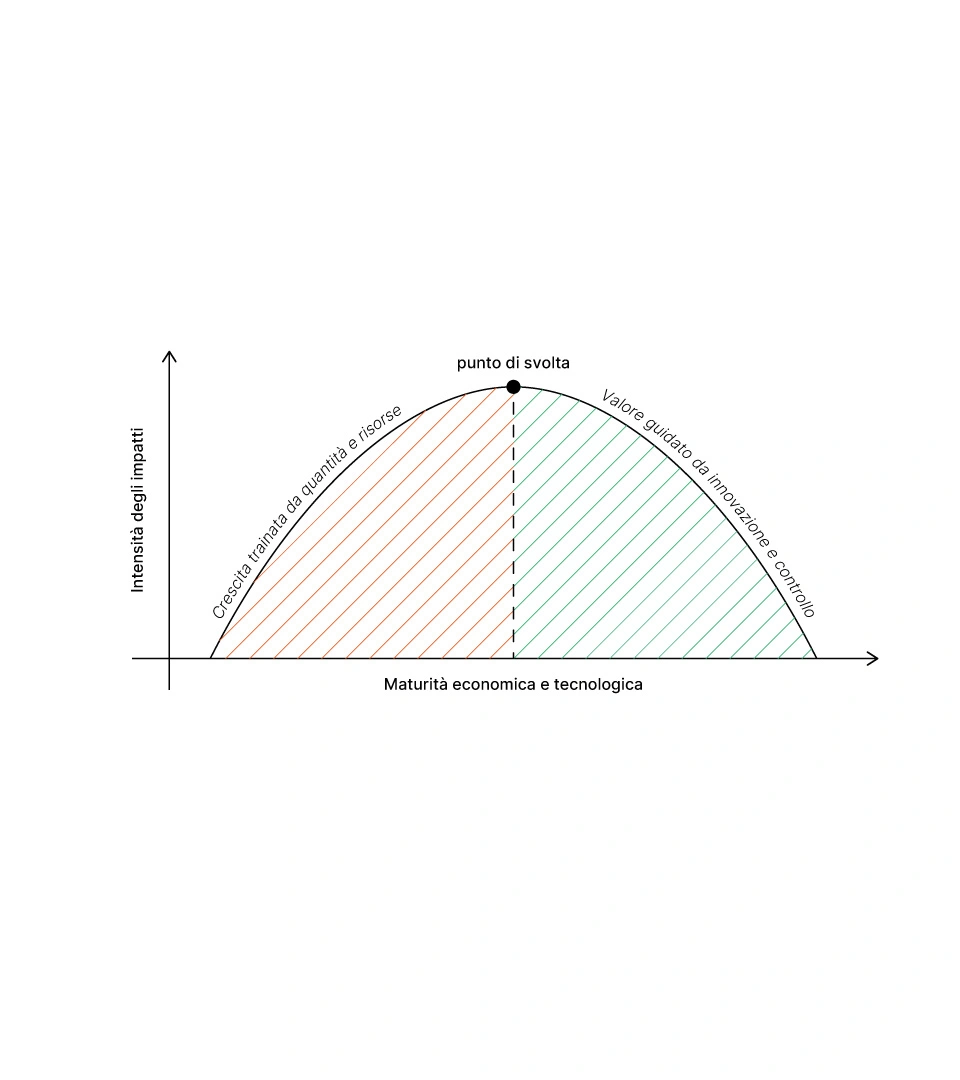
The environmental Kuznets curve can be read as an interpretive framework: not an automatic law, but a way to explain that, in more mature economies, competitive advantage tends to shift from quantity and improvisation toward innovation, control, technological quality and reduced intensity of impacts.
In construction and fit-out, this means focusing on more controlled processes, fewer variations, greater efficiency in the use of resources and better quality of space.
In other words: sustainability not as an added cost, but as an upgrade to how value is produced.
03 · Cost-benefit analysis
Why sustainability pays off
Evaluating sustainability as a cost-benefit analysis means not stopping at the initial cost, but measuring overall effects over time. A better-coordinated project reduces errors and rework; a more efficient building or space reduces consumption and maintenance; stronger governance increases reliability and transparency.
| Initial investments | Direct economic benefits | Indirect and strategic benefits |
|---|---|---|
| Advanced design and coordination | Fewer errors, delays and variations | Greater reliability as perceived by the client |
| LCA / carbon footprint / measurement analysis | Lower maintenance and operating costs | Better positioning with finance and ESG requirements |
| Higher-performing systems and materials | Greater energy and usage efficiency | More comfort, appeal and value over time |
04 · Our ESG approach
Our ESG approach
Three complementary dimensions — environmental, social and governance — that together define how we work and build value.
Environment
Reducing impacts across the life cycle
LCA, carbon footprint, recyclable materials, design that eliminates what's unnecessary, waste reduction and greater durability. In Build this translates into BIM, prefabrication, off-site construction and variable control; in Design into integrated systems, comfort and efficient use of space.
Social
Value for people, inside and outside the company
Social covers both the quality of spaces for those who use them and how we build our organisation. Environmental comfort, acoustics, light, air quality and accessibility go hand in hand with health and safety, people's growth, inclusion, organisational flexibility, work-life balance and quality of work.
Governance
Method, transparency and accountability
Sustainability is only credible if it's governed. That's why we focus on detailed budgeting, clear processes, defined responsibilities, a code of ethics, reporting and management standards. A sustainable project must also be transparent to govern and legible in its economic decisions.
05 · Application
How it translates across our brands
| Grandi Build | Grandi Design |
|---|---|
| Process industrialisation, BIM, upfront coordination, dry steel construction, reduced construction-site variables, more controllable schedules, durability and optimised maintenance. | Environmental comfort as a measurable value, acoustics, air quality, lighting, integrated systems, spatial flexibility, non-invasive installation and everyday efficiency. |
| Goal: reduce unforeseen issues, waste and the intensity of impacts across the building's life cycle. | Goal: improve wellbeing, performance and experience quality in workspaces and hybrid environments. |
06 · Measurement
Measuring in order to improve
For us, measuring isn't about building a narrative — it's about improving decisions. Sustainability has to become a system of indicators, not a statement. That's why Grandi's roadmap involves the progressive development of environmental, social and governance metrics, integrated into company and project processes.
Roadmap
2026 – 2027- 01Integration and consolidation of the quality, environmental and safety management system (ISO 9001, ISO 14001, ISO 45001)
- 02First Sustainability Report
- 03Gender equality certification path in line with the UNI/PdR 125:2022 reference practice
- 04Definition of a Code of Ethics / Code of Conduct and strengthening of internal governance
- 05Development of integrated ESG metrics: LCA, carbon footprint, project KPIs and company KPIs
- 06Assessment of tools and practices supporting inclusion, equal opportunity and accountability